


Updated November 28, 2026: added the City of Rancho Palos Verdes damage survey.
If your South Bay home shook on Saturday morning, the next 72 hours are for checking the house for gas, water and structural damage, accounting for every person and pet, setting a family plan that works without a cell phone, and restocking the supplies you will want if a stronger aftershock arrives. A magnitude 5.0 earthquake struck at 9:30 a.m. on Saturday, November 28, 2026, centered offshore about 3 miles (5 km) southwest of Manhattan Beach and about 8 miles (12.8 km) deep, according to the U.S. Geological Survey (USGS). A magnitude 4.5 aftershock followed at 11:41 a.m. As of 5:34 p.m. Pacific, the USGS catalog listed 87 aftershocks within about 8 miles of the epicenter, 18 of them magnitude 2.5 or larger.
What happened in the Manhattan Beach earthquake on November 28, 2026?
A magnitude 5.0 earthquake hit offshore in Santa Monica Bay at 9:30 a.m., about 3 miles southwest of Manhattan Beach, and a magnitude 4.5 aftershock followed at 11:41 a.m., by USGS figures. More than 26,000 people filed “Did You Feel It?” reports with the USGS. The Los Angeles Fire Department (LAFD) said there were “no initial reports of structural damage or injuries,” Spectrum News 1 reported.
Closer to home, Hermosa Beach closed its pier at 10:10 a.m. “until further notice due to earthquake/hazardous conditions,” and Manhattan Beach closed its pier at 11:05 a.m. “as a precaution due to the recent earthquake,” Easy Reader reported. The City of El Segundo reported a “contingency flaring incident” at the Chevron refinery at 9:53 a.m. and later said there was “no public threat.” Neither the city nor Chevron has said whether the quake caused the flaring. The National Tsunami Warning Center said there was no tsunami danger, and seismologist Lucy Jones called significant damage “highly improbable,” Easy Reader reported.
On the Peninsula, the City of Rancho Palos Verdes said Saturday that damage surveys by its Public Works staff and the Los Angeles County Fire Department “identified no significant impacts in the City.” Rancho Palos Verdes residents can report damage to their property to the city’s Building and Safety Division at [email protected], the city said in a post on its official Instagram account.
FREE PRINTABLE CHECKLIST
Earthquake Preparedness Household Checklist
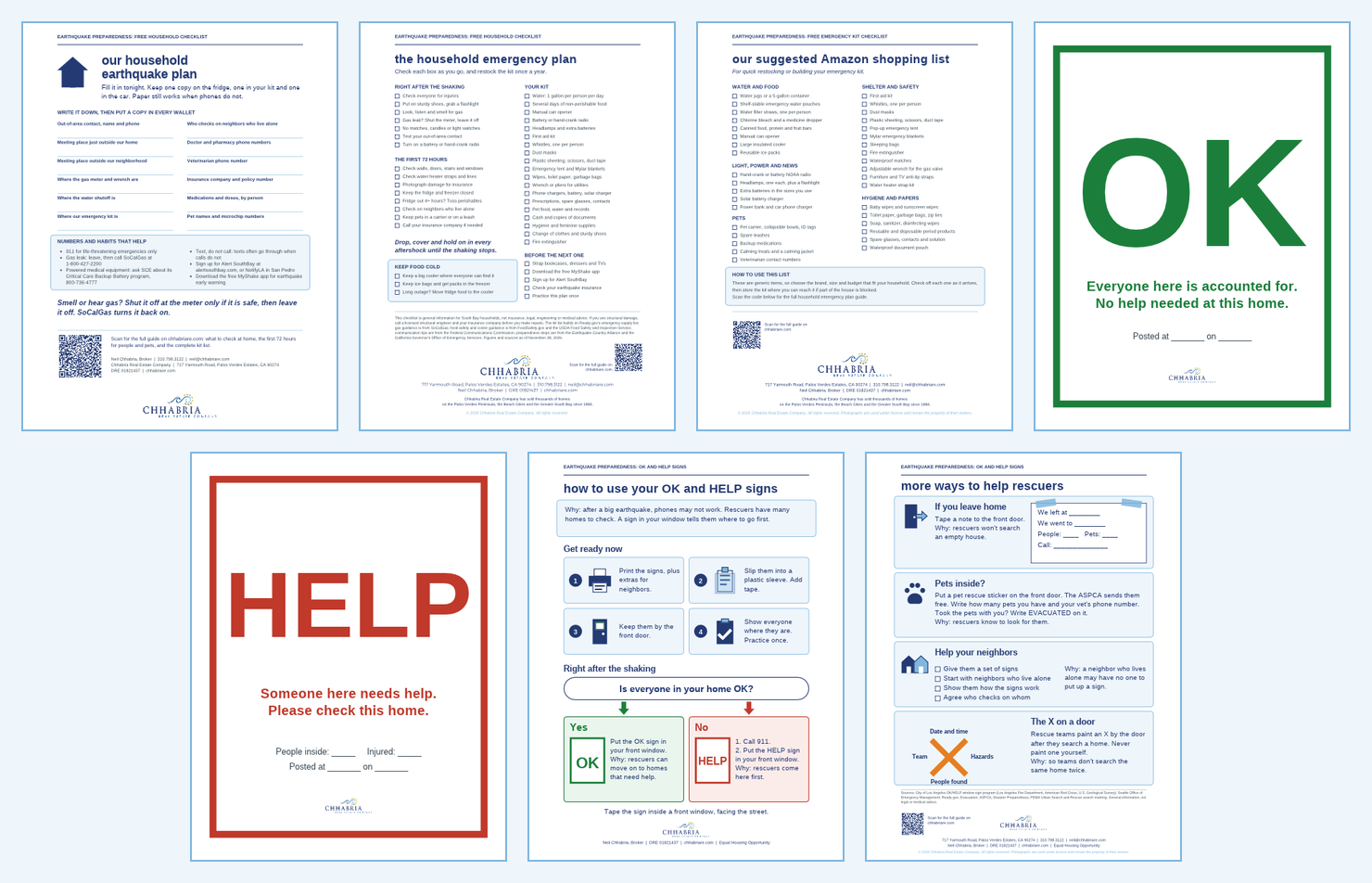
We’ve prepared checklists for you so you can refresh and review your household emergency plan.
Practice the plan at home so everyone can be on the same page about your household meet-up plan, where emergency supplies are in the house, etc. Also, a bonus shopping list for your emergency kit (if you are still building yours).
What’s in the download?
- Our household earthquake plan, to fill in, keep and practice with the household
- The household emergency plan: steps to take when the shaking stops and the first 72 hours after
- Our suggested Amazon shopping list, for restocking and/or building your emergency kit
- An OK sign, full page, for your front window
- A HELP sign, full page, for your front window
- How to use your OK and HELP signs, with step-by-step instructions
- More ways to help rescuers go door-to-door more efficiently, and what the “X” symbol on the door means
NO REGISTRATION REQUIRED
How likely is another strong aftershock this week?
More shaking is likely. The USGS aftershock forecast updated at 3:40 p.m. on November 28 gives an 86% chance of at least one magnitude 3 or larger aftershock in the next day and a 19% chance of magnitude 4 or larger. For magnitude 5 or larger, the odds are 2% in the next day and 5% in the next week.
THE ODDS FOR THE NEXT WEEK, PER THE USGS
- Magnitude 3 or larger: 99%
- Magnitude 4 or larger: 40%
- Magnitude 5 or larger: 5%, about 1 in 20
A 5% chance works out to about 1 in 20 that something as strong as Saturday’s main quake arrives within seven days, and 19 in 20 that it does not. Aftershocks can happen minutes, days, weeks or even months after an earthquake, the Centers for Disease Control and Prevention (CDC) says. When one hits, drop, cover and hold on until the shaking stops, the same way you would in the main quake.
What should you check around your house right after an earthquake?
Check for gas leaks first, then water, electrical and structural damage. SoCalGas says to turn off your gas meter only if you smell gas, hear it escaping or see other signs of a leak, and only if it is safe to do so. Then look at walls, ceilings, chimneys, the water heater and windows before anyone settles back in.
THE GAS RULE
- Smell gas, hear a hiss or see a broken line: get everyone out.
- Shut the meter only if it is safe, with a 12-inch or larger adjustable wrench.
- Call SoCalGas at 1-800-427-2200 from outside, or 911 if anyone is at risk.
- Leave the meter off. SoCalGas turns it back on.
- No matches, lighters, candles or light switches until you know there is no leak.
Gas. If you smell natural gas or hear a hiss, get everyone out and call SoCalGas at 1-800-427-2200 from a safe place, or 911 if anyone is at risk. If you shut off the meter, leave it off; SoCalGas says not to turn it back on yourself, because interior piping and appliances must be inspected first, and after a large earthquake that can take time. Do not use matches, lighters, appliances or light switches until you are sure there is no leak; a spark can ignite gas, the CDC warns. SoCalGas says to keep a 12-inch or larger adjustable wrench with your emergency supplies, never stored on the meter or gas piping.
Water heater. California Health and Safety Code section 19211 requires every residential water heater to be braced, anchored or strapped against earthquake motion. Look for a tank that shifted, straps that pulled loose, or a gas or water line that bent or drips.
Structure. The California Seismic Safety Commission says to check for structural damage, look for gas leaks, electrical hazards and water damage, stay out of unsafe buildings and expect aftershocks. In my experience, doors that suddenly stick, new cracks at the corners of doors and windows, a chimney that pulled away from the wall, or stucco that fell are reasons to call a licensed structural engineer before your family sleeps inside.
Inside the house. Wear sturdy shoes against broken glass and debris. Open cabinets slowly, since items may have shifted against the door. Photograph any damage before you clean up, for your insurance company, as the Seismic Safety Commission recommends.
Food. Keep the refrigerator and freezer closed if the power goes out. FoodSafety.gov says a refrigerator keeps food cold for about 4 hours with the door shut, and a full freezer holds its temperature for about 48 hours (24 hours if half full). After 4 hours without power, throw out refrigerated meat, poultry, fish, eggs and milk. The USDA Food Safety and Inspection Service says to have a large insulated cooler and frozen gel packs ready, and to keep ice in the freezer for the cooler. If the outage will run past 4 hours, move refrigerated food into the cooler with the ice and keep it at 40°F or below. Keep the cooler where everyone in the house knows to find it.
What are the best things to do in the first 72 hours after an earthquake?
In the first hour, check people for injuries, check for gas and fire, and send one short text to an out-of-area contact. In the first day, inspect the house, photograph damage and keep phone calls brief. On days two and three, check on neighbors, keep supplies in use, and stay ready for aftershocks.
The first hour:
- Check yourself and everyone in the home for injuries. Call 911 only for a life-threatening emergency.
- Look, listen and smell for gas. Put out small fires if it is safe; otherwise call 911.
- Put on shoes and grab a flashlight or headlamp.
- Text your out-of-area contact that you are safe and where you are, then stay off the phone so emergency calls can get through.
The first day:
- Inspect the house using the checks above, and photograph damage.
- Turn on a battery-powered or hand-crank radio for official updates.
- Keep the refrigerator and freezer closed.
- Charge phones and power banks while you have power, or from the car.
Days two and three:
- Check on neighbors who live alone or rely on medical equipment, in person if the phones are down.
- Drop, cover and hold on through each aftershock.
- Call your insurance company if you found damage.
How do you keep loved ones safe, including older relatives and anyone with medical needs?
Anyone who depends on daily medication, oxygen or powered medical equipment needs a supply that outlasts an outage and a person nearby who knows the plan. Ready.gov recommends a list of all medications, dosages and allergies, extra eyeglasses, hearing aids and batteries, and a backup supply of oxygen.
Medications. Ready.gov recommends keeping an extra supply of prescription medications. Ask your doctor or pharmacist how to get one, and keep copies of prescriptions in your kit.
A support network. Ready.gov recommends a small group of family, friends or neighbors who know where your supplies are kept. Giving one of them a key means someone can check on a parent or neighbor in person when the phones do not work.
Powered medical equipment. Southern California Edison’s Critical Care Backup Battery program offers free portable backup batteries for medical devices to eligible customers, with delivery, setup and training at no cost. Eligibility runs through SCE’s Medical Baseline Allowance program and depends on where you live; call SCE at 800-736-4777 to ask.
Everyday needs. Ready.gov suggests charged devices with familiar videos and activities and spare chargers for anyone who finds a disruption hard. A walker, cane or wheelchair should stay within reach of the bed.
How do you keep pets safe after an earthquake?
Keep pets close, in a carrier or on a leash, while aftershocks continue, and make sure each one can be identified if it gets loose. Ready LA County says to register your pet’s microchip and keep the microchip company’s phone number with your important papers.
The CDC recommends writing your pet’s name, your name and your contact information on each carrier, and packing food and water, bowls, medications and vaccination records. Ask your veterinarian for copies of your pet’s records now, while the office is open. Ready.gov has a full pet kit list.
How does your family stay in touch if cell towers are down or phone batteries are dead?
Text instead of calling, and agree on the plan before you need it. The Federal Communications Commission (FCC) says text messages often go through when calls do not. Each person should carry a written contact list, know one out-of-area contact, and know two meeting places: one just outside your home and one outside your neighborhood.
THE NO-PHONE PLAN
- Every number on paper, in every wallet, backpack and car.
- One out-of-area contact everyone checks in with.
- Meeting place 1: just outside the house.
- Meeting place 2: outside the neighborhood, in case you cannot get home.
- A battery or hand-crank radio for news when phones and internet are down.
The plan on paper. Phones die and contacts live inside them. Write down every family member’s number, your out-of-area contact, your doctors, your veterinarian and your insurance policy number, and keep a copy in each wallet, each backpack and the car.
One out-of-area contact. The Earthquake Country Alliance recommends a contact outside the area. Everyone in the household texts or calls that one person, who passes messages along.
Two meeting places. Pick one spot right outside the house, such as a neighbor’s driveway, and one outside the neighborhood, such as a school or park, in case you cannot get home.
Battery power. The FCC recommends dimming your screen, disabling apps you are not using and keeping a car charger or solar charger on hand. A charged power bank buys days of texting.
Official alerts. Sign up for Alert SouthBay, the official emergency message system for the City of Manhattan Beach. A battery-powered or hand-crank radio still works when phones, internet and power do not.
How do South Bay households get emergency alerts after an earthquake?
Earthquake early warning comes through the State of California’s Earthquake Warning California system: the free MyShake app, Android Earthquake Alerts and Wireless Emergency Alerts on your phone. What to do after a quake, such as evacuation orders and shelter locations, comes from your city’s alert system, so the sign-up depends on where you live.
- Manhattan Beach, Hermosa Beach, Redondo Beach, El Segundo, Torrance, Palos Verdes Estates, Rancho Palos Verdes, Rolling Hills Estates and Rolling Hills use Alert SouthBay, the regional system these cities share with Inglewood, Gardena, Hawthorne, Lawndale, Lomita and Carson. Register at alertsouthbay.com or text ALERTSB to 888777. Torrance residents enrolled in TorranceAlerts and Rolling Hills Estates residents on its NIXLE list were moved over and do not need to register again.
- San Pedro is part of the City of Los Angeles, which sends emergency alerts through NotifyLA.
- On the Palos Verdes Peninsula, look up your evacuation zone before you need it: How to find your evacuation zone on the Palos Verdes Peninsula.
What should you buy and stock up on for an earthquake kit?
Start with water, food, light, a radio and first aid. Ready.gov’s emergency supply list starts with about one gallon of water per person per day for several days, for drinking and sanitation, and at least a several-day supply of non-perishable food. A household of four needs 12 gallons for three days.
The basics, from Ready.gov’s emergency supply list:
- Water, one gallon per person per day for several days
- Non-perishable food for several days, and a manual can opener
- Battery-powered or hand-crank radio
- Flashlight and extra batteries
- First aid kit
- Whistle to signal for help
- Dust masks, plastic sheeting and duct tape
- Moist towelettes, garbage bags and plastic ties for sanitation
- Wrench or pliers to turn off utilities
- Local maps
- Cell phone chargers and a backup battery
Additions Ready.gov suggests:
- Prescription medications, eyeglasses and contact lens solution
- Pet food and water
- Cash
- Copies of important documents in a waterproof container
- A sleeping bag or warm blanket for each person
- A change of clothing and sturdy shoes
- Fire extinguisher
- Matches in a waterproof container
- Household chlorine bleach and a medicine dropper to disinfect water
- Feminine supplies and personal hygiene items
- Paper and pencil
- Books, games or puzzles
What we add for a South Bay household:
- A headlamp for each person, so your hands stay free for a gas valve, a door or a child
- A whistle for each person, not one for the house
- A pop-up emergency tent and Mylar emergency blankets, in case the house is not safe to sleep in
- Shelf-stable emergency water pouches, which store in a car or a go bag where gallon jugs will not fit
- A personal water filter straw for each person, as a backup to stored water and never a replacement for it
- Spare glasses and extra contact lenses
- Baby wipes, toilet paper and sunscreen wipes
- A solar battery charger, so phones and the radio keep going after the power bank runs out
- Reusable menstrual products alongside disposables
- A large insulated cooler kept where everyone knows to find it, with bags of ice and gel packs stored in the freezer
Our suggested Amazon shopping list for quick restocking is page 3 of the free checklist, with a box to check as each item arrives. Store the kit where you can reach it if part of the house is blocked, and check it once a year for expired food, water and batteries.
FREE PRINTABLE CHECKLIST
Earthquake Preparedness Household Checklist
We’ve prepared checklists for you so you can refresh and review your household emergency plan.
Practice the plan at home so everyone can be on the same page about your household meet-up plan, where emergency supplies are in the house, etc. Also, a bonus shopping list for your emergency kit (if you are still building yours).
What’s in the download?
- Our household earthquake plan, to fill in, keep and practice with the household
- The household emergency plan: steps to take when the shaking stops and the first 72 hours after
- Our suggested Amazon shopping list, for restocking and/or building your emergency kit
- An OK sign, full page, for your front window
- A HELP sign, full page, for your front window
- How to use your OK and HELP signs, with step-by-step instructions
- More ways to help rescuers go door-to-door more efficiently, and what the “X” symbol on the door means
NO REGISTRATION REQUIRED
How should you prepare your home for the next earthquake?
Secure what can fall, plan how your family will reconnect, store supplies, and sign up for early warning. The Earthquake Country Alliance’s Seven Steps to Earthquake Safety start with securing your space and making a plan before the next quake, and California’s free MyShake app can give seconds of warning before shaking arrives.
Secure your space. Strap tall bookcases, dressers and televisions to wall studs, move heavy items to low shelves, and make sure the water heater straps are tight. Saturday’s quake was a fair test of what in your home moves.
Plan to be safe. Fill in the household plan on page 1 of the free checklist and practice it once, including the walk to your second meeting place.
Get early warning. MyShake, from the California Governor’s Office of Emergency Services (Cal OES) and UC Berkeley, sends alerts for magnitude 4.5 or larger quakes expected to cause weak shaking or stronger where you are. Many Android phones in California get alerts automatically, without the app.
Minimize financial hardship. Find your homeowner’s insurance policy and confirm whether it includes earthquake coverage. The Earthquake Country Alliance lists earthquake insurance among the steps that help a household recover, and the California Earthquake Authority explains its policies. Our post on insuring a hillside or coastal home in the South Bay covers what a buyer checks before the contingency ends.
Get trained. The City of Manhattan Beach runs Community Emergency Response Team (CERT) classes, which teach basic disaster response for your home and your block.
This is general information, not insurance, legal or engineering advice. If you see structural damage, call a licensed structural engineer, and call your insurance company before you make repairs.
Buying, selling, or still deciding if the Beach Cities are where you’ll settle down next?
Neil Chhabria, Broker
Is there a free printable earthquake checklist for South Bay homes?
Yes. We made a free, seven-page printable earthquake checklist for households in Manhattan Beach, Hermosa Beach, Redondo Beach, El Segundo, Torrance, the Palos Verdes Peninsula and San Pedro, and there is no registration to download it. It has a fill-in household plan, the steps for when the shaking stops and the first 72 hours, a shopping list for building or restocking your emergency kit, full-page OK and HELP window signs with step-by-step instructions, and what the X that search teams paint by a door means. Download the checklist, or read every list on our free earthquake checklist for South Bay homes page.
Sources
- City of Rancho Palos Verdes, official Instagram post on the earthquake damage surveys, November 28, 2026
- U.S. Geological Survey, M 5.0, 5 km SW of Manhattan Beach, CA (event ci41581136), catalog read 5:50 p.m. Pacific, November 28, 2026
- U.S. Geological Survey, M 4.5, 7 km WSW of Manhattan Beach, CA (event ci41581512)
- U.S. Geological Survey, Aftershock Forecast for event ci41581136, updated 3:40 p.m. Pacific, November 28, 2026
- Easy Reader, Mark McDermott, “5.0 quake off Manhattan Beach closes piers; Chevron refinery flares,” November 28, 2026
- Spectrum News 1, “Strong 5.0 magnitude earthquake rattles SoCal,” November 28, 2026
- SoCalGas, Emergency Preparedness and How to Shut Off Your Natural Gas
- Centers for Disease Control and Prevention, Safety Guidelines: After an Earthquake
- California Seismic Safety Commission, Response and Recovery
- California Health and Safety Code section 19211
- FoodSafety.gov, Three Ways to Keep Food Safe When You Lose Power
- USDA Food Safety and Inspection Service, Keep Your Food Safe During Emergencies
- Ready.gov, Build a Kit; Individuals with Disabilities; Prepare Your Pets for Disasters
- Southern California Edison, Critical Care Backup Battery Program
- Ready LA County, Animal Preparedness
- Centers for Disease Control and Prevention, Be Prepared: Pet Safety in Emergencies
- Federal Communications Commission, Tips for Communicating in an Emergency
- Earthquake Country Alliance, Seven Steps to Earthquake Safety
- Cal OES, Earthquake Warning California and the MyShake App
- City of Manhattan Beach, Emergency Preparedness (Alert SouthBay; CERT)
- California Earthquake Authority
Keep exploring the South Bay
Have a question about this? Neil answers personally.