

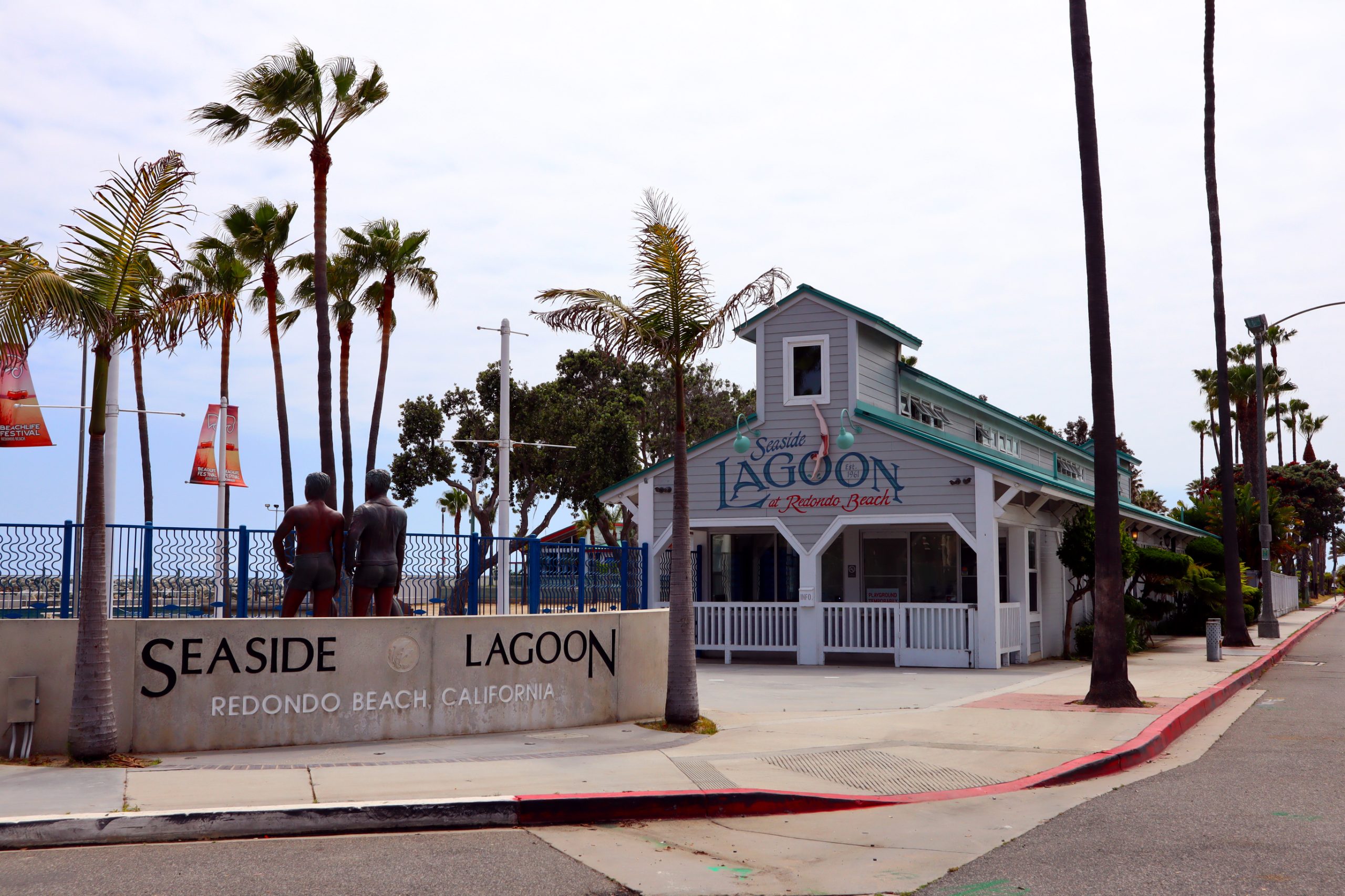
Status as of September 17, 2026. This is a developing situation. The Redondo Beach City Council has voted to file an application. Nothing has been permitted and nothing is under construction. The decision that matters next belongs to the California Coastal Commission, which has not scheduled it.
We update this page when something actually happens rather than when something is announced. If you are reading it months from now, check the date above against the date you are reading.
On Tuesday, September 15, 2026, the Redondo Beach City Council voted unanimously to send its Seaside Lagoon rehabilitation plan to the California Coastal Commission, declining to pause the project to study a wave pool alternative. Mayor Jim Light announced it the same night in a public statement that opened, “Sometimes being Mayor is no fun,” and went on to call the vote “a massive victory for the community.”
Both halves of that are worth taking seriously. It is the furthest this project has moved in twenty years, and it is still an application, not a permit. Anyone who owns or is shopping near King Harbor in Redondo Beach should read this week’s news by sorting it into three piles: what is funded, what is filed and what is still an idea.
What did the Redondo Beach City Council decide about Seaside Lagoon?
The council directed staff to complete and submit a Coastal Development Permit application for the first phase of the lagoon’s rebuild at 200 Portofino Way, and approved the project’s environmental exemption, according to Patch’s report on the meeting. The alternative was delay: hold the filing and look at other concepts, including an artificial wave pool. In the mayor’s words, the council voted to file “the current plan with no wave pool.”
Light wrote that he has been in discussions about rehabilitating the lagoon since 2006. “Now after 20 years we have a defined solution and the funding to get it done,” he wrote, before qualifying it in the same sentence: “at least phase 1.” His summary of where things stand: “We have never been anywhere near this close to construction.”
He also did not pretend the room was unanimous even if the vote was. He described friends and people he respects on both sides, acknowledged “a bunch of disappointed people,” and called it “a divisive issue.”
What will the rebuilt Seaside Lagoon look like?
Phase 1 replaces the lagoon itself and the systems that run it. The design presented to the Harbor Commission in August and carried to the council calls for a swimming area of roughly one acre holding about 770,000 gallons, with a maximum depth of five feet. Swimmers walk in from a sand beach at zero depth and the floor transitions to concrete as it deepens. The plan includes a water slide, splash and fountain features, an entry that meets accessibility standards, new restrooms, shade and picnic areas, landscaping and fencing.
The larger change is one visitors will never see. Today’s lagoon holds about 1.5 million gallons drawn from beyond the breakwater, chlorinated on the way in and sent back out, as the city’s own facility page describes. The new lagoon recirculates. Water is filtered at about 3,000 gallons per minute, a full turnover roughly every 4.3 hours, in place of a constant discharge to the harbor.
Why is the city rebuilding it now?
Because the existing system has become expensive to keep alive. The city reported about $175,000 in water quality fines over a two year cycle, and a pump failure in 2025 closed the lagoon for two weeks and cost roughly $60,000 to repair. The lagoon is closed for the 2026 season. A flow-through saltwater pool that discharges to a harbor is a difficult thing to operate under current water quality rules, and a closed recirculating system removes the discharge from the equation.
An earlier, more ambitious version paired the recreational lagoon with a separate lap pool. County health officials required independent filtration for each, which pushed the estimate past $16 million, and that version was set aside.
How much does Phase 1 cost, and who is paying?
The first phase was estimated at about $9.47 million as of April 2026. The state appropriated $10 million toward the lagoon’s rehabilitation, first reported by Easy Reader in 2021, and the city has committed $1 million of its own. Ahead of the August Harbor Commission hearing, staff put the combined state and city money still available at roughly $7.9 million, a gap of about $1.57 million that they proposed closing with Quimby funds, the park fees California cities collect from new residential development.
Only Phase 1 is funded and defined. The mayor called it “the foundation for the rest of the phases,” and those later phases have neither a budget nor a schedule yet.
What happened to the wave pool idea?
Allen Sanford, who founded the BeachLife Festival and the California Surf Club, presented a concept built around a large artificial wave pool with a smaller zero-depth lagoon beside it, a surf school, open beach, volleyball, a dining deck and a bar. A separate $10 million wave pool pitch from Raised Water Research was circulating the same week, as The Inertia reported.
Neither was before the council for approval. Patch reports that Light made that point himself and noted the city was not negotiating with Sanford. The practical argument for filing now is the one that usually wins in coastal California: a designed, funded project with state money attached is worth more than a better idea that restarts the entitlement clock.
Whether the wave pool conversation is finished is a separate question. The vote settled what gets filed. It did not settle what people want, and the Coastal Commission process includes public comment.
When could construction start, and when would it reopen?
No start date exists. The Coastal Commission holds final permitting authority and sets its own calendar. If approvals come through as city staff has planned, construction runs about ten months, with completion targeted for early 2028, ahead of the BeachLife Festival that May and the Los Angeles Olympic Games that summer. Until a permit is issued, that is a target and nothing firmer.
What else did the mayor say is moving in King Harbor?
Light used the same statement to list the rest of the harbor’s pipeline, which he summed up as “phenomenal progress in just a few years after decades of stagnation.” Some of it we could verify against city pages and prior reporting. Some of it, as of today, rests on his statement alone. The table keeps the two apart, because the stage each project has reached is the whole story.
| Project | What the mayor said | Stage today | Who decides next | Verified beyond his statement? |
|---|---|---|---|---|
| Seaside Lagoon, Phase 1 | “A defined solution and the funding to get it done” | Application authorized, not yet permitted | California Coastal Commission | Yes. Patch, city records |
| Public boat ramp | “Community consensus on the location,” with a design submitted to the state for funding | Grant application filed February 2026 for a launch on Mole D | State Division of Boating and Waterways. Award recommendations January 2027, state budget July 2027 | Yes. City project page |
| Marine Mammal Care Center at the former Joe’s Crab Shack | An agreement for a “$30M+ facility” after “seven years of vacancy” | Option agreement approved spring 2026 | The nonprofit’s fundraising. It must raise $15 million, the first $4 million within months of launch | Yes. The Log, Easy Reader |
| Former Fun Factory site | “An ENA with Level Up” for bowling, an arcade and a bistro | Exclusive negotiating agreement, which is a commitment to negotiate a lease and not a lease | City and the operator | Not yet. Mayor’s statement only |
| Market hall, north end of the International Boardwalk | The council “took the first step” the night of the lagoon vote | Earliest stage. No operator, design or budget reported | City Council | Not yet. Mayor’s statement only |
| Monstad Pier buildings, including the vacant Maison Riz space | An application to refurbish the buildings on both sides of the pier | Application stage | City review, then likely coastal review | Not yet. Mayor’s statement only |
Six projects, six timelines, and four of them turn on a party outside City Hall: the Coastal Commission, a state grant cycle, a nonprofit’s capital campaign and a private operator’s lease negotiation. Light closed his statement with “We are truly living the renaissance of Redondo.” That is a mayor’s characterization, offered the night of a vote he supported, and readers should weigh it as one. What the record supports today is narrower and still significant: more of the harbor is in motion at once than at any point in recent memory, and almost none of it is finished.
We will move the three unverified rows to verified, or correct them, as staff reports and agreements are published.
What does this mean if you own or are buying near the Redondo Beach harbor?
Three practical things.
Price the property on what exists. An application to the Coastal Commission is a meaningful milestone and it is not a finished lagoon. The housing closest to the water, including the condominiums at The Village and Seascape and the blocks along Catalina Avenue and the Esplanade, trades today against a harbor with a closed lagoon and several vacant buildings. A buyer is purchasing current conditions with a documented set of approvals in motion. That is a reasonable thing to value. It is a different thing from the 2028 rendering.
Know what the construction year looks like. If the permit arrives on the city’s preferred schedule, ten months of work at Portofino Way and Harbor Drive falls inside 2027. Owners who plan to sell in that window should expect buyers to ask about it, and a seller who can hand over the project timeline and funding sources is in a stronger position than one who cannot.
Use the facts precisely. Public capital going into a waterfront within walking distance is a legitimate part of a listing’s story, and it persuades only when it is stated accurately: funded, filed, permitted or open. In a market measured by price per square foot, the owners and buyers who follow entitlement stages closely are the ones who avoid paying for something early or selling before it counts. Our pages on South Redondo Beach, how the Coastal Commission shapes South Bay property and current South Bay market figures carry the detail, and our West Harbor piece applies the same test to San Pedro’s waterfront.
If you own near the harbor and want to know how this changes the timing of a sale, send Neil the address.
What happens next, and what are we watching?
This is not finished, and it will move again. The next dates that mean something are the filing of the Coastal Development Permit application, the Coastal Commission hearing once it is scheduled, the state boating grant recommendations in January 2027, the Marine Mammal Care Center’s first fundraising milestone, and whether the Level Up negotiation produces a signed lease. Any of them can slip, and one of them slipping does not mean the others will.
So treat this article as a snapshot. If you are weighing a decision on a specific property, the facts that matter are the ones in force the week you write the offer or sign the listing, not the ones in force when this was written.
Sources
- Mayor Jim Light, public statement on Facebook following the September 15, 2026 City Council meeting. All quotations attributed to the mayor are from this statement unless noted.
- Patch, “Redondo Moves Forward With Seaside Lagoon Overhaul,” September 16, 2026
- Patch, “Major Seaside Lagoon Overhaul Heads To Redondo Beach Harbor Commission,” August 2026
- City of Redondo Beach, Seaside Lagoon
- City of Redondo Beach, Public Boat Launch
- Easy Reader, Marine Mammal Care Center option agreement, April 2, 2026
- The Log, “Marine Mammal Care Center Eyes Redondo Beach Expansion,” May 21, 2026
- The Inertia, wave pool proposal, September 16, 2026
Written September 17, 2026, two days after the council vote. Last reviewed September 17, 2026. This article is general real estate information, not tax, lending, legal or investment advice. Project details, costs and schedules are as reported on the dates shown and are subject to change by the City of Redondo Beach and the California Coastal Commission.
Keep reading
Have a question about this? Neil answers personally.