
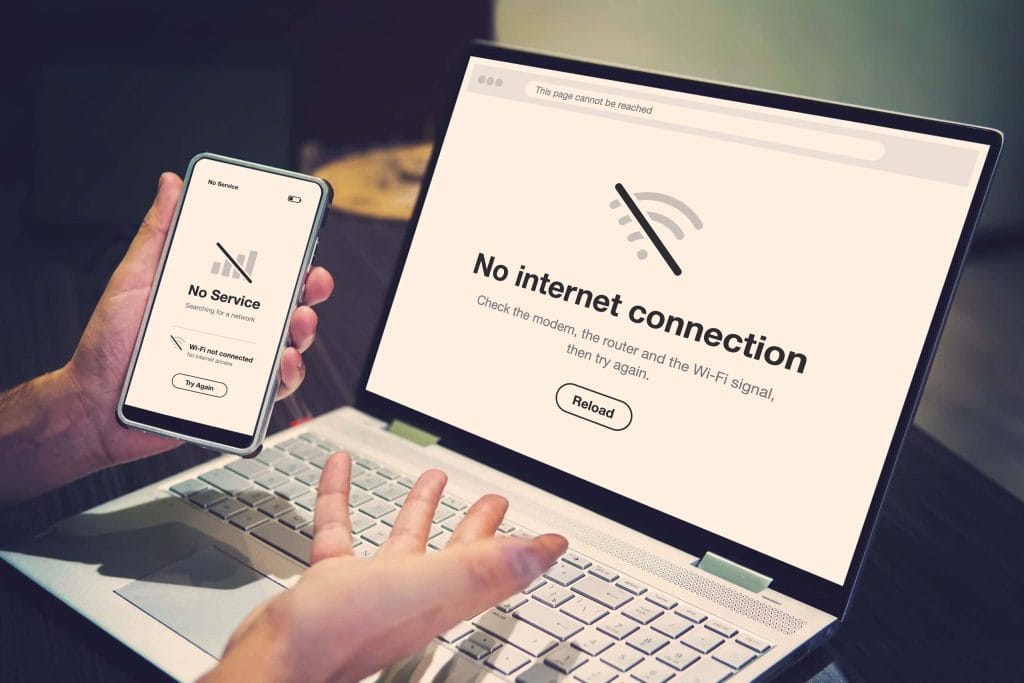
A video call that freezes in the back bedroom. One bar of signal at the bottom of a canyon road. A detached studio behind the garage that the house Wi-Fi does not reach. None of it shows at an open house.
Cell signal and home internet can both be checked by address before you write an offer, using two free maps and one walk through the house with your own phone. CoverageMap shows the speeds real phones recorded on AT&T, T-Mobile and Verizon. The FCC’s National Broadband Map lists which internet companies report service at the address and the fastest speeds they advertise there. Bookmark both. The walk through the house confirms what the maps suggest.
What should a buyer check, and when?
There are two separate services to check. Cell service comes over the air from your phone carrier. Home internet comes into the house on a cable or fiber line from an internet company, and the Wi-Fi in the house is that connection shared over a router. A house can be strong on one and weak on the other, and each is looked up on a different map.
The first look takes a few minutes, so it fits before an offer, at the same point a buyer checks the commute. The house test fits the inspection period. California’s standard purchase contract gives a buyer 17 days by default for inspections and other investigations, and our page on what happens after the offer lists what usually goes into those days. A general home inspection looks at the structure and its systems. Signal and internet service are outside it, so this check belongs to the buyer.
How do you check cell coverage at an address?
Search the address on CoverageMap’s interactive map and compare AT&T, T-Mobile and Verizon side by side. The site is built from speed tests run on people’s own phones, more than 13 million of them by its own count. For each carrier it reports download speed, upload speed, latency and a reliability score from 0 to 10.
Download speed is how fast things arrive on your phone. Upload speed is how fast you send, and on a video call it is the upload that carries your face and voice to everyone else. Latency is the delay between sending and receiving, and a long delay is why people talk over each other on a call.
CoverageMap’s national medians show why upload deserves a look of its own: 112.2 megabits per second down and 10.4 up. The sending side is about one eleventh of the receiving side. For a South Bay buyer who works from home, the upload figure at the address says more about a day of video meetings than the headline download number does.
The map has limits. It can only show results where someone has run a test, so a short street may have few readings. It also covers the three national carriers and 36 smaller brands that run on their networks, so check the map under the carrier your own plan uses. The site is free, with paid extras, and is run by CoverageMap LLC.
The FCC’s National Broadband Map has a mobile tab as a second opinion. Its coverage comes from the carriers’ own reports, and the FCC states that the map “does not include information on the availability of mobile wireless broadband service while indoors.” The agency adds that real experience “may vary due to factors such as the end-user device used to connect to the network, cell site capacity, and terrain.”
Terrain applies on the Palos Verdes Peninsula, where streets climb ridges and drop into canyons within a few blocks. In January 2025 the City of Rancho Palos Verdes held an open house on a Verizon proposal for a cell tower at Hesse Park, which the City’s notice said was meant “to improve cell coverage.”
After the maps, the remaining step is a test inside the house. During a showing or an inspection, turn Wi-Fi off on your phone and make a call from the rooms where you would work, the garage, the yard and any detached unit. If the people in your household use different carriers, test each phone.
How do you check which internet providers serve an address?
Enter the address at the FCC’s National Broadband Map and open the Fixed Broadband tab. It lists each company that reports offering service at that location, the technology it uses, such as fiber, cable, fixed wireless or satellite, and the maximum download and upload speeds it advertises there. The FCC’s instructions walk through the search.
The companies are not the same from one South Bay city to the next. The City of Manhattan Beach lists Charter Spectrum and Frontier Communications as its cable providers. Rancho Palos Verdes carries its city channel on Cox Cable and Frontier FiberOptic. A move from the Beach Cities to the hill can mean a new internet company, a new installation appointment and different equipment.
Frontier also changed hands this year. Verizon completed its purchase of Frontier on January 20, 2026, after the California Public Utilities Commission approved it on January 15, so a Frontier line at an address may now appear under either name.
Two cautions apply to the FCC listing. The data is reported by the providers themselves, and a maximum advertised speed is the fastest plan offered, which may cost more than the plan you would buy. A call to the provider with the exact address confirms that service can be installed there, what it costs and how long the installation wait is. If the map is wrong about an address, the FCC takes corrections through the Availability Challenge link on the map.
In a condominium or townhome, one more question goes to the homeowners association: whether the building has a bulk internet contract, and whether an owner may bring in a different provider.
What about an ADU or a detached home office?
An Accessory Dwelling Unit, or ADU, is a second, smaller home on the same lot as a house. California permitted 1,336 of them in 2016 and 30,354 in 2024, according to the state housing department’s ADU Handbook, and in 2024 they were more than one in four of all homes permitted statewide. A detached unit needs its own answer on both signal and internet.
For a buyer, that means running the same phone test inside the ADU or studio as in the house, and asking where its internet comes from. A unit that shares the main house’s Wi-Fi depends on the distance and the walls between the two buildings. A unit with a cable run from the house, or its own service line, does not.
For an owner planning to build, the question to put to the internet provider is whether the address can take a second service line, since a tenant may want an account of their own. The least expensive time to bury a data cable between the house and the unit is while the utility trench is open.
What if coverage is weak at a house you like?
Weak signal at a house has three common fixes, and the maps show which one applies. CoverageMap shows whether a different carrier is stronger at that address. Many phones and carriers support Wi-Fi calling, which places calls over the home internet connection and moves the question to the internet line. A signal booster is a third route.
The FCC’s rules on consumer signal boosters are short: buy one that carries the Consumer Use label, and register it with your wireless provider before using it. Registration is free.
Checking early gives a buyer time. A carrier switch, an installation appointment or a wiring quote arranged during the inspection period is in place on move-in day. For an owner preparing to sell, the same two maps show what a buyer will see when they look up the address.
The two bookmarks
- CoverageMap: cell speeds by address and by carrier, from tests on real phones.
- FCC National Broadband Map: internet providers, technology and advertised speeds by address, with a mobile tab.
Buying, selling, or still working out which part of the South Bay fits? Our buying guide covers the rest of the process, and you can send Neil the address you are weighing.
Sources
- CoverageMap, United States cell coverage: carriers covered, test count, national medians and reliability score method.
- Federal Communications Commission, What’s on the National Broadband Map and How to Use the FCC’s National Broadband Map.
- Federal Communications Commission, Signal Boosters FAQ.
- City of Manhattan Beach, Cable Television; City of Rancho Palos Verdes, RPVtv and open house notice for the Hesse Park proposal, January 2025.
- Verizon, Introducing Frontier, a Verizon Company, January 20, 2026; California Public Utilities Commission, approval of the Verizon and Frontier acquisition, January 15, 2026.
- California Department of Housing and Community Development, ADU Handbook, March 2026.
We do our very best to supply facts drawn from official sources so that the information you find here is reliable and accurate. If we find conflicting information, we report on all of it. This article is general real estate information. It is not legal, technical, tax, lending, financial or investment advice. Coverage maps and provider listings are published by third parties and change often, and results at any one address can differ from what a map shows, so confirm service with the carrier or provider before relying on it. Chhabria Real Estate Company has no affiliation with CoverageMap or with any carrier or internet provider named here and receives nothing for mentioning them. Chhabria Real Estate Company, DRE 01821437.


