
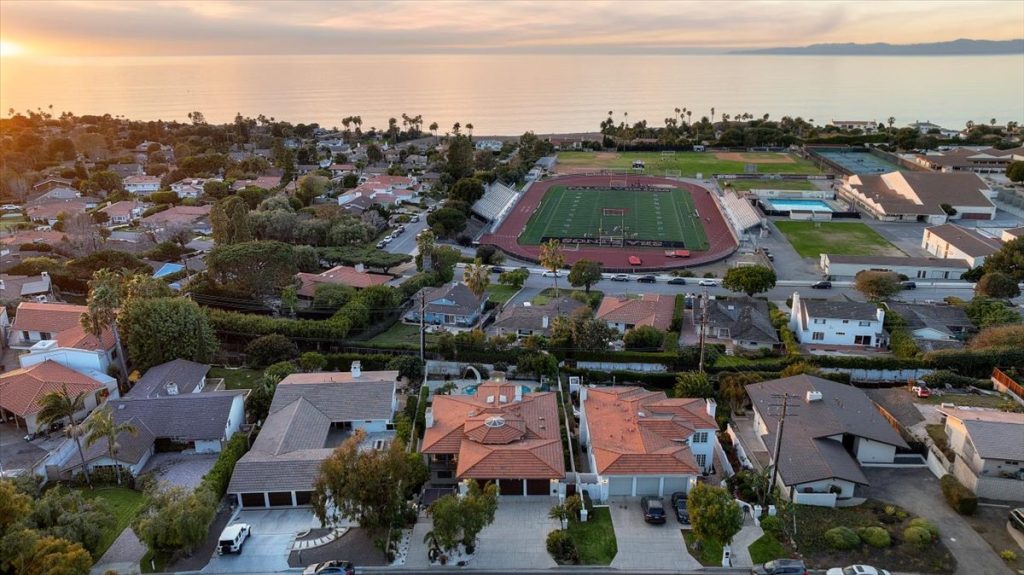
Updated October 15, 2026. A cross-country team strung out along Palos Verdes Drive North at 6:45 in the morning. Band buses idling on Silver Spur Road on a Friday night. Surfboards on roof racks in the lot off Cloyden Road before first period. Two high schools, one district, and a thank-you that is overdue.
Niche’s 2027 Best Public High Schools in California list, published this fall, places Palos Verdes Peninsula High School at number 24 and Palos Verdes High School at number 40 out of 2,036 public high schools in the state, each with an overall grade of A+. Both are Palos Verdes Peninsula Unified School District schools. The ranking is Niche’s, built by Niche’s method, and we report it here as news. The congratulations are ours.
To the teachers who grade on Sunday nights, the counselors, coaches, custodians, office staff and bus drivers, the parents who run the booster clubs and the carpools, the Peninsula Education Foundation and everyone who writes it a check or walks for it, and most of all to the students who show up and do the work: congratulations. A district is a set of boundaries on a map. A school is the people inside it, and this result belongs to them. Learn more about our local Palos Verdes schools here.
What does the Niche ranking measure?
Niche publishes its method with the list. For the 2027 edition, 60 percent of a school’s score is an Academics grade built from state assessment results, college enrollment data and survey responses from students and parents. The rest comes from a Culture and Diversity grade (12.5 percent), overall-experience surveys (10 percent), a Teachers grade that includes teacher pay and state test results (10 percent), and smaller weights for clubs, facilities and sports. The underlying statistics come from the U.S. Department of Education and state education departments, and the survey answers come from Niche users. The full table is on Niche’s methodology page.
Niche’s page for Peninsula High lists 2,075 students and 728 reviews; its page for Palos Verdes High lists 1,484 students and 433 reviews. Both show a student-teacher ratio of 22 to 1.
How do schools show up in home prices?
Economists have been measuring this for a long time. Charles Tiebout wrote the theory in 1956: households shop for a town the way they shop for anything else, and the local services, schools included, are part of what they buy. Wallace Oates tested it in 1969 across 53 northern New Jersey towns and found that, after allowing for the tax rate, the towns that spent more per pupil had higher home values. That paper is the first published measurement of school quality as something home buyers pay for.
The cleanest measurement came in 1999, when Sandra Black compared houses on either side of elementary attendance boundaries in the Boston suburbs. The houses sat on the same streets and were the same kind of house; only the assigned school differed. A 5 percent difference in test scores came with a price difference of about 2.5 percent. A 2007 study of the San Francisco Bay Area by Patrick Bayer, Fernando Ferreira and Robert McMillan found roughly half that once neighborhood characteristics were held constant.
The national picture is in a 2012 Brookings Institution report by Jonathan Rothwell, Housing Costs, Zoning, and Access to High-Scoring Schools. Across the 100 largest metropolitan areas, homes near high-scoring public schools were worth $205,000 more on average than homes near low-scoring ones, and housing there cost about 2.4 times as much per year.
Put those figures on a Peninsula price. On a $2,500,000 house, 2.5 percent is $62,500. If you own here, that is already inside your comparable sales; the buyers who set the last five closing prices on your street were paying for the district along with the view and the lot. If you are buying here, you pay it once, at closing, and it holds as long as the community keeps funding the schools. In Neil’s experience, buyers moving to the Palos Verdes hills from outside the South Bay ask about the two high schools before they ask about the ocean.
What has community support done for South Bay schools?
California gives its school districts no dedicated money for buildings. Roofs, pipes, science labs and gyms are paid for by local bond measures that need 55 percent of the vote, and by the state matching funds those local bonds unlock. In the South Bay, the record of saying yes is long, and Redondo Union High School is the clearest example of what it buys.
Redondo Beach Unified passed Measure E in November 2000 and Measure C on February 5, 2008, both with more than 65 percent of the vote; Measure C authorized $145 million and passed at 65.92 percent. The district says the two measures modernized classrooms, upgraded a high school it called 100 years old, and renovated libraries, science and computer labs, cafeterias and multipurpose rooms at the elementary and middle schools. At Redondo Union, the Measure C work that broke ground in July 2009 was a $33.75 million package: a new gymnasium and aquatic center, an artificial-turf football field and new tennis courts, a student services building for administration, counseling, attendance, the registrar, the nurse and student government, and a modernized auditorium and band building. Measure Q, a $63 million bond approved in November 2012, followed with technology, electrical and energy work, including the solar arrays on a dozen district campuses.
On November 5, 2024, Redondo Beach voters approved Measure S, a $278 million bond for roofs, plumbing, heating and cooling, portable classroom replacement and security, at about 66 percent according to Easy Reader’s election coverage. The district told LAist that the average age of its schools is over 70 years. The estimated cost is $29.95 per $100,000 of assessed value a year, and the district’s board presented its Redondo Union project list in May 2026.
The Peninsula voted the same day. Measure SOS, a $297.8 million bond for Palos Verdes Peninsula Unified, passed with 57.43 percent, the district’s first facilities bond in almost 20 years. The district’s own case for it was blunt: an average campus age near 60 years, science labs untouched for six decades, about 45 classrooms and buildings with leaking roofs the year before, and a melted electrical panel that closed Miraleste Intermediate for three days. The first $75 million of bonds sold on February 20, 2025 at a true interest cost of 3.49 percent. Ground broke on the first project, the Miraleste Intermediate pool, on September 14, 2025. The Phase One campuses, where architects and district staff held site meetings in October 2025, are Palos Verdes High, Peninsula High, Miraleste Intermediate, Lunada Bay, Montemalaga and Rancho Vista, and the board approved Phase One design agreements for six modernization projects that November. The district estimates the cost at $29 per $100,000 of assessed value, about $300 a year for a typical owner.
If you have owned on the Peninsula since the 1990s, your assessed value sits far below market under Proposition 13, so Measure SOS costs you a few hundred dollars a year while the campuses your home’s value leans on get rebuilt. If you buy a Peninsula house for $2,500,000, your assessed value resets to the price, and the same measure runs about $725 a year. Both of you are paying for the same thing, and the 1999 and 2012 studies above say the market has been pricing it in since before either measure existed.
How does high school choice work in Palos Verdes?
There is no high school attendance boundary in Palos Verdes Peninsula Unified. The district’s enrollment page states it in one line: students living within district boundaries may choose to attend either Palos Verdes High School, at 600 Cloyden Road in Palos Verdes Estates, or Palos Verdes Peninsula High School, at 27118 Silver Spur Road in Rolling Hills Estates. Your address sets your elementary and intermediate school. It does not set your high school.
For a household, that means each child can land where the programs fit. One can choose Peninsula High and a sibling can choose Palos Verdes High, and nobody moves. Buyers from districts with hard boundaries often do not know this until they are already touring houses, and it changes which streets they are willing to consider. The district publishes the selection window for incoming ninth graders each year on its enrollment dates page, and both schools hold open houses before it. Eastview, the part of Rancho Palos Verdes that sits inside Los Angeles Unified, is an optional attendance area, so students there may also choose a Palos Verdes Peninsula Unified school.
Niche’s rankings will move next year, and the year after. What stays is the district’s enrollment rule, the bond program now in construction, and the people at both campuses who earned this fall’s result. Congratulations again to all of them.
Buying, selling, or still deciding if the South Bay is where you’ll settle down next? Neil Chhabria, Broker, 310.798.3122, neil@chhabriare.com. There is no obligation.
Sources
- Niche, 2027 Best Public High Schools in California, and the Best Public High Schools methodology page, read October 13, 2026.
- Palos Verdes Peninsula Unified School District: School Locator and enrollment page (high school enrollment statement, Eastview); History of Measure SOS; Timeline of Bond Program (last updated June 22, 2026). The timeline page gives the approval date as November 5 and the vote as 57.43 percent; one line on that page prints the year as 2025, which is a typo for 2024.
- Redondo Beach Unified School District, About Measure Q (Measures E, C and Q history); Measure S presentations page (RUHS projects, May 2026).
- Ballotpedia, Redondo Beach Unified School District Measure C, February 2008, with Los Angeles County certified results.
- REBusinessOnline, July 10, 2009, on the $33.75 million Redondo Union High School construction and modernization.
- LAist, Measure S: Redondo Beach Unified School District facilities bond, October 16, 2024. Easy Reader, Redondo Beach election results, November 2024.
- Jonathan Rothwell, Housing Costs, Zoning, and Access to High-Scoring Schools, Brookings Institution, April 19, 2012.
- Charles Tiebout, A Pure Theory of Local Expenditures, Journal of Political Economy, 1956. Wallace Oates, The Effects of Property Taxes and Local Public Spending on Property Values, Journal of Political Economy, 1969. Sandra Black, Do Better Schools Matter? Parental Valuation of Elementary Education, Quarterly Journal of Economics, 1999. Patrick Bayer, Fernando Ferreira and Robert McMillan, A Unified Framework for Measuring Preferences for Schools and Neighborhoods, Journal of Political Economy, 2007. These journals are behind subscriptions, so they are named here and not linked.
This article is general information, not legal, tax or investment advice. The high school ranking and grades are Niche’s, produced by Niche’s published method, and are reported here as a news item; Chhabria Real Estate Company does not rank schools. Bond figures are from each district’s own pages on the dates shown, and the research findings are summarized from the studies named above. Chhabria Real Estate Company, DRE 01821437. Equal Housing Opportunity.


