

Updated October 16, 2026.
Open house flags going up along Prospect. A moving truck holding up both lanes on Catalina. Somebody’s dog tied to the rail outside the coffee counter. In Chicago last Wednesday, the mortgage industry handed federal regulators a list of twenty things it wants changed.
None of it is law. On October 14, 2026, at its annual convention, the Mortgage Bankers Association published “Affordability in Action: A Policy Roadmap to Lower the Cost of Owning and Renting a Home.” It is a trade association asking federal agencies for things. Nothing in it changes what you pay for a mortgage this week.
What makes it worth twenty minutes anyway: almost none of it needs Congress. These are changes Fannie Mae, Freddie Mac, the Federal Housing Administration, the Department of Veterans Affairs and the banking regulators could make on their own authority. That is a far shorter path than a bill.
What is in the roadmap?
Twenty recommendations across five areas: lowering the upfront and monthly cost of a mortgage, opening credit to more qualified borrowers, lowering the cost of financing and building rental housing, expanding the supply of affordable housing, and strengthening the housing finance system long term.
Five of those twenty would reach a South Bay buyer directly. The rest are aimed at lenders, apartment developers and bank regulators.
Which parts would reach a South Bay buyer?
The credit report you pay for
Fannie Mae and Freddie Mac currently require lenders to pull all three credit bureaus on every borrower. MBA wants that requirement replaced, with a single report allowed for borrowers scoring above 700 and the full pull kept for higher-risk loans. MBA says the cost of the three-bureau report has risen three- to four-fold over five years and that the change would save borrowers hundreds of dollars.
This is a flat fee on the loan file. It lands the same whether the house is in Hermosa Beach or Harbor City, which makes it the most evenly shared item on the list.
FHA mortgage insurance
MBA asks the FHA to cut its annual mortgage insurance premium by 20 basis points, paired with tighter underwriting where several risk factors stack up on one file. MBA’s own example: a borrower with a $400,000 loan saves nearly $800 a year.
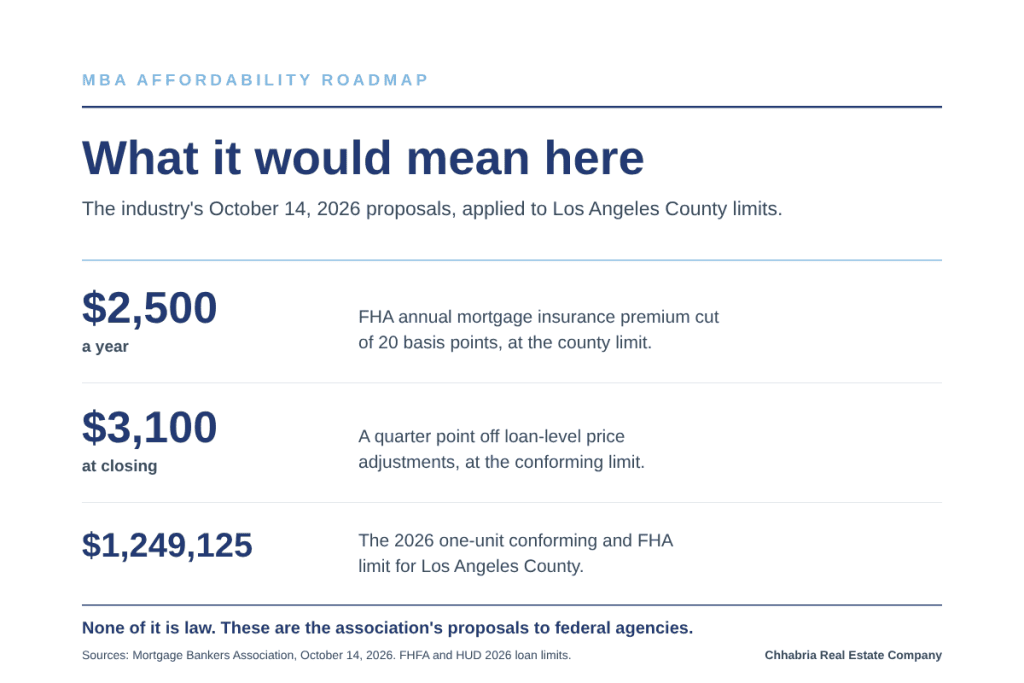
What that looks like here. The 2026 FHA limit for a single-unit home in Los Angeles County is $1,249,125, which is the national ceiling. A South Bay buyer borrowing at that limit would save roughly $2,500 a year on the same 20 basis points. That is a little over $200 a month, every month, for as long as the premium is charged.
The Fannie and Freddie fee most buyers never see
Loan-level price adjustments are fees Fannie and Freddie charge based on credit score, down payment and other characteristics. They rarely appear as a line item. They show up inside the rate or as points at closing. MBA asks for them to be lowered and aligned on owner-occupied purchases, and gives a quarter-point cut on a $400,000 loan as saving $1,000 at the closing table.
What that looks like here. The 2026 conforming limit in Los Angeles County is also $1,249,125. A quarter point on a loan that size is about $3,100 at closing.
Above that number the loan is a jumbo, Fannie and Freddie are not in the transaction, and loan-level price adjustments do not apply at all. So this one reaches a South Bay buyer financing at or under the conforming limit, and does nothing for a jumbo purchase.
Title insurance
MBA wants a streamlined title product that strips out duplicated work between the lender’s coverage and the owner’s. The paper puts title costs at 0.5 to 1.0 percent of the purchase price.
Treat that range as the direction of MBA’s argument instead of a local quote. California’s title and escrow practice is its own system, and what a South Bay buyer pays depends on the company, the policy and who customarily pays in that city. At the paper’s own national range, a $2,000,000 purchase carries $10,000 to $20,000 of title cost, which is why the item is on the list at all.
Condominium financing
The roadmap asks for simpler condominium guidelines aimed at first-time buyers.
For the beach cities this is the item with the longest reach. A large share of entry-level inventory here is condominiums and townhomes, and condo financing already turns on project-level questions a buyer cannot control: the association’s budget, its reserves, its insurance and its litigation. Anything that simplifies those guidelines widens the pool of buyers who can finance that inventory. If you own a beach-cities condominium, that pool is your resale market.
Which parts would not touch this market?
Plainly, so nobody waits on something that will not arrive:
- A jumbo buyer gets nothing from the loan-level price adjustment item and nothing from the FHA premium item.
- A cash buyer gets nothing from any of the financing items.
- The rental and multifamily sections are written for apartment developers, owners and their lenders.
- MBA also takes positions on federal prevailing wage rules and on state and local rent control and eviction moratoriums. Those are advocacy positions in a national paper. California’s rules on those subjects are set in Sacramento and at city hall, not by the agencies this roadmap addresses.
Is any of it close to happening?
One piece has moved further than the rest, and it is the credit report.
HousingWire reported on October 12, 2026 that MBA’s president and chief executive, Bob Broeksmit, told the convention, “I am increasingly confident that tri-merge won’t be around for long.” The same report has the Federal Housing Finance Agency’s director saying a two-bureau option is under consideration, with a single-pull option being studied.
No agency has announced a change. As of October 16, 2026, the three-bureau requirement is still the rule, and every other recommendation in the roadmap sits with the agency it was addressed to.
What should you do about it right now?
Nothing about your financing changes this week, and no one should wait on a regulator before making a decision about a house. The numbers that move your payment today are still the rate you lock and the price you negotiate. Our what can I afford in the South Bay page runs both of those at today’s numbers.
If any of these does take effect, you will not learn it from a headline. You will see it as a smaller number on a loan estimate. The practical move is to ask your lender to walk you through the fee lines on that estimate, this year and next, and to notice if one of them shrinks.
What we are reporting next
Our South Bay market report published Tuesday, October 20, with the twelve months through September: days on market, share of original asking price and months of inventory for each market we cover. If FHFA or FHA acts on anything in this roadmap, it goes in the report that follows.
Buying, selling, or still deciding if the South Bay is where you’ll settle down next?
Neil Chhabria, Broker
Chhabria Real Estate Company, DRE 01821437
310.798.3122, neil@chhabriare.com
Sources
- Mortgage Bankers Association, “MBA Releases ‘Affordability in Action’ Policy Roadmap to Lower the Cost of Buying and Renting a Home,” October 14, 2026. Read October 16, 2026. MBA press release.
- Mortgage Bankers Association, Housing Affordability Policy Roadmap, the paper’s page. Read October 16, 2026. Housing Affordability Policy Roadmap.
- Federal Housing Finance Agency, conforming loan limit values for 2026. Read October 16, 2026. FHFA Announces Conforming Loan Limit Values for 2026.
- U.S. Department of Housing and Urban Development, Mortgagee Letter 2025-23, 2026 nationwide forward mortgage loan limits. Read October 16, 2026. Mortgagee Letter 2025-23.
- U.S. Department of Housing and Urban Development, FHA 2026 areas at the ceiling, the list that puts Los Angeles County at the one-unit ceiling of $1,249,125. Read October 16, 2026. FHA 2026 Areas at Ceiling.
- Flavia Furlan Nunes, “Bob Broeksmit says tri-merge ‘won’t be around for long,'” HousingWire, October 12, 2026. Read October 16, 2026. HousingWire.
This is general real estate information, not tax, lending, legal or investment advice. Figures attributed to the Mortgage Bankers Association are that association’s own estimates and have not been independently verified. Loan limits and premiums change; confirm any figure with your own lender before relying on it. Stats presented here represent the city or area as a whole, not any one individual property.


